The Second Life of the Buttonhole: Where UK Wedding Flowers Go on Sunday Morning

There is a moment at almost every British wedding, somewhere between the last song and the first bin bag, when somebody looks at forty jam jars of hydrangeas and asks the question nobody really wants to answer. What happens to all this now?
Historically, the answer has been a skip. Increasingly, it is a van.
Midnight: the table clearers
Picture a Saturday in late September. The marquee is still warm, someone's uncle is doing a final, slightly emotional lap of the dance floor, and the bride's aunt has quietly started recruiting. Two cousins, a godmother, and a man called Dave who turns out to be exceptionally good at stacking crates.
What they are doing is not tidying up. It is the first stage of a flower run — a handover that begins with centrepieces and buttonholes and ends, roughly fourteen hours later, with a bouquet on a bedside table in a hospice, a care home or a community centre several miles away.
The idea is simple enough that it is slightly baffling it took so long to become common. Wedding flowers are, by and large, at their absolute best on the Sunday morning after the wedding. They have been conditioned, watered and arranged by someone who knew what they were doing. They have another five or six good days in them. And on that same Sunday morning, there are people in every UK town who would be genuinely thrilled by a bucket of them.
The van, the buckets, the cold tap
The mechanics vary from place to place, but the shape is usually the same. A florist agrees in advance to come back — or to send a Saturday-night volunteer — with crates of clean buckets and a supply of water. The venue agrees to leave the flowers in place rather than sweeping them into bin liners at 11pm, which is often what a tired cleaning team would prefer. The couple, or more often a bridesmaid with a clipboard, has already decided who is taking what.
Foliage gets stripped of anything wilted. Oasis foam — the green stuff that holds a lot of hand-tied arrangements together — is separated out, because it does not compost and it does not belong in a hospice bin. Everything drinkable goes into fresh water, and everything broken goes home with the florist.
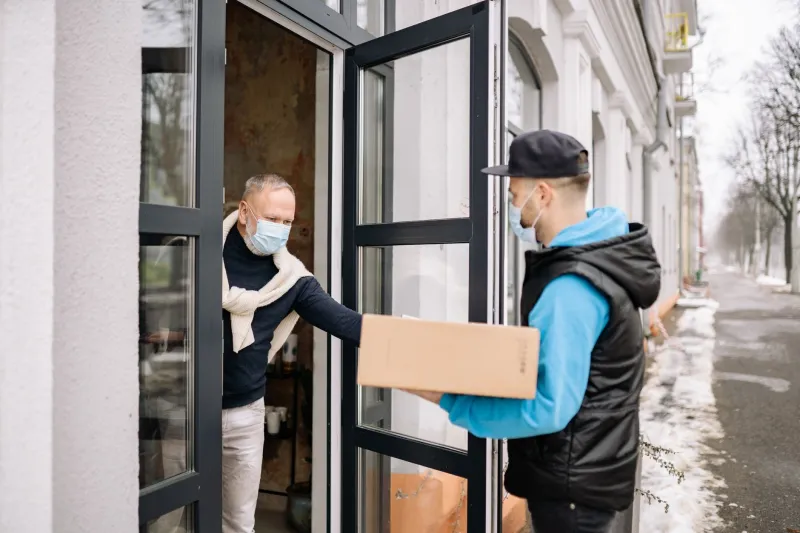
Then comes the part that makes the whole thing work: the Sunday delivery. A rota of volunteers, usually organised through a local florist, a church, a Women's Institute branch or a hospice's own fundraising team, takes the buckets and splits them into small, manageable bunches. Not grand arrangements. A few stems, wrapped in brown paper or stood in a jam jar, sized for a windowsill.
What hospices actually want
This is where good intentions need a gentle word. Hospice staff are enormously grateful for donated flowers, but they are also managing infection control, allergies and limited space.
The general rule of thumb across UK hospices and care homes runs roughly like this: no lilies (heavy pollen and a scent that can overwhelm a small room), nothing too strongly perfumed, nothing that sheds, and no glass that could break in a corridor. Short-stemmed, already-arranged bunches are much easier for staff than a bucket of loose stems and a hopeful expression. And it is worth ringing the hospice reception or the activities coordinator before you promise anything — Sunday opening hours and delivery entrances are not always what you would expect.
Some sites ask for arrangements that can be wiped down. Some will only accept flowers that have not been in a home with pets. Almost all would rather have ten neat posies than forty stems and a problem.
The practical bit, if you fancy doing it
If you are getting married in 2026 and like the sound of this, the good news is that it takes about twenty minutes of admin to arrange and roughly one conversation to make it stick.
Start with the florist. Ask whether they already do a Sunday collection, and if not, whether they can leave crates and buckets behind on the Saturday. Independent British florists are often the ones with the best local contacts — they will know which hospice has a Sunday trolley round and which care home has a resident who adores freesias.
Talk to the venue. Get the flower policy in writing, ideally in the same email as the timings. Some venues recycle their own arrangements into their Sunday carvery; others are delighted to hand them over. Ask specifically that flowers are not binned at midnight.
Then find a recipient. Hospices, care homes, community centres, women's refuges, church communities, lunch clubs and hospital wards are all worth ringing. Two things to check: whether they can accept on a Sunday, and who signs for the delivery.
Finally, sort the transport. One car, three crates, one very calm friend. That is genuinely the whole operation.
The bit nobody photographs
The wedding photographs will not include the moment the crates go into the boot. They will not show the care home manager on the phone at 9am saying yes, please, we have a birthday on the ward today. And they certainly will not show the look on a stranger's face at half past ten on a wet Sunday morning when a bunch of somebody else's roses arrives at the door.
But that is the whole point. A wedding is a very loud, very lovely statement about one family. Passing the flowers on is a quieter one — that the celebration does not have to stop at the gate, and that the prettiest thing on the table can still be doing its job long after the last guest has gone home.